Tony Cragg
385 Broadway New York, NY 10013
10 September - 24 October 2026
Opening Reception: Thursday, 10 September, 6 - 8 pm


Marian Goodman Gallery is delighted to announce a solo exhibition of new work by Tony Cragg, which will be on view from 10 September - 24 October 2026. The Gallery's first solo exhibition of the renowned British sculptor in our Tribeca space, our seventeenth solo exhibition with the artist, will feature new sculptures in bronze, wood, stone, and steel. Cragg, recipient of this year's European Culture Prize, will be honored on 4 September 2026 at the Royal Concertgebouw Amsterdam.
For more than 50 years, Cragg has transformed a dynamic range of materials to create a vast range of singular, sculptural entities. Cragg sees sculpture as a radical use of materials combatting the repetitive monotony and generic dullness of forms that are the product of the simple geometries of our production systems. Cragg has said, 'as a race we are responsible for the impoverishment of form on this planet. Sculpture as a non-utilitarian use of material is free to produce new forms, new ideas, new emotions, new terms and hence new freedoms.'
While crisscrossing the lines between realism and abstraction he takes inspiration from both natural and man-made forms, thereby continually reimagining and drawing out the relationship between man and Nature.Versus' frontal orbital structure pulsates with shifting elliptical forms, greeting the visitor upon entry. Expressing a multiplicity of themes within Cragg's work, from axial views to pure materiality, mass, and flux, to hybrid forms and structural accretions, it sets the stage for the exhibition.
In the ground floor space, new sculptures in Corten steel, Path, 2026, and Recall, 2025, suggest the dynamic build up and cascade of material things in the world, of ideas, history, and sculptural form. As in his Hedge series Cragg uses Corten, a very strong material, moving outwards towards what is elemental, radical, and open ended in sculpture. From the organic to the metaphoric, Path expresses its own identity as a fountain, a waterfall, a road, a path. Nearby, three new Stand works rest on tripod feet, resembling forms that are both bodily and akin to landscape - a torso, a bluff or a cliff - all cast from carvings that precisely articulate line, surface and volume.
Over the Earth, 2026, in bronze, supports a large overhead horizontal form and takes up a more figurative theme as found in sculptures like Justine, 2021. It is a large abstract structure whose flow of forms shows a sinewy musculature. The spread of the similarly muscular horizontal form suggests wings, arms or branches. Caught in suspension, the form appears to look down on itself and the earth below. The special significance of Heaven as taught to us has been lost, for Cragg there is no escape, we happily accept our moribund existence and responsibility for our own existence.
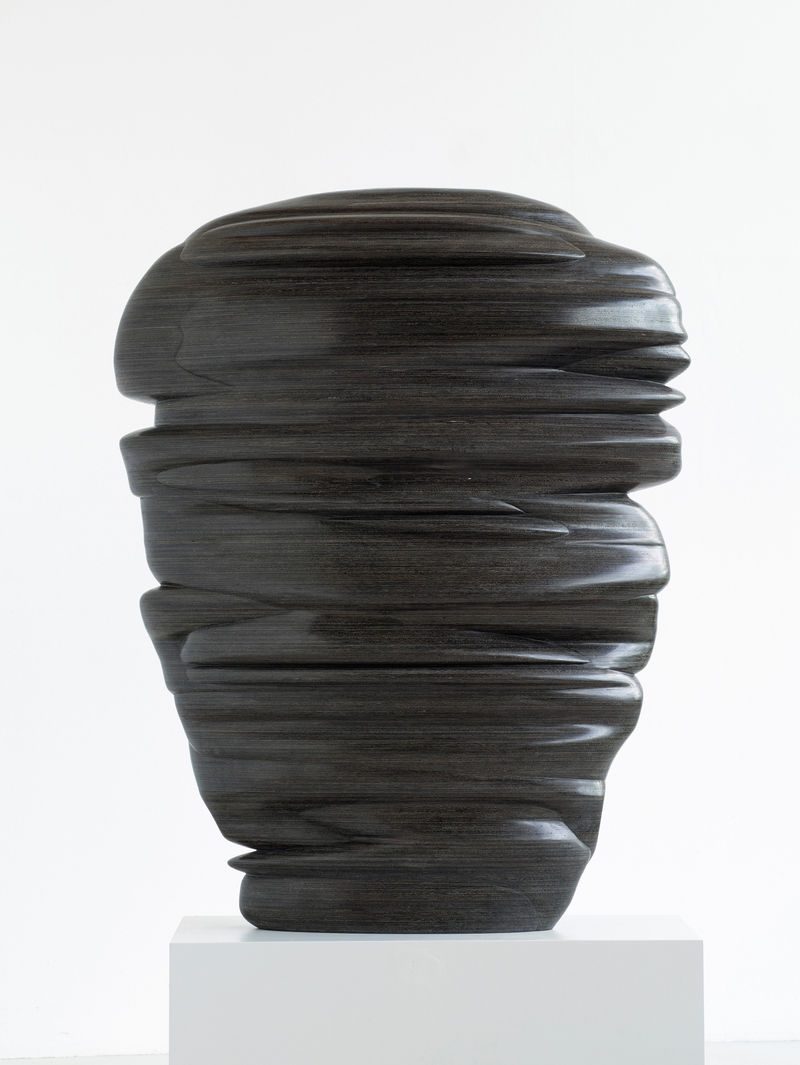
In the large-scale wooden Stack, 2026, Cragg takes to stacking as a sculptural technique as he has done since his early works in the early 1970's. He is fascinated by all kinds of stratification and layering, whether in the landscape or, in organic forms because it always infers growth and with that time and change.
In No Time is also a complex stacked form in which a number of inclined, conjoined columns each intersect and overlap to create an image of collision and coalition, flux and speed, with a baroque complexity that is reminiscent of some Renaissance sculpture in the portrayal of dynamic metamorphic movement.
In the third floor gallery, Symmetries are new works based on axial line drawings that were mirrored to form symmetric columns. The simple process of mirroring created these astonishingly figurative forms that display any number of apparent anatomic characteristics. Cragg was not attempting to represent the human figure but in mirroring the columns he had drawn he found that proportionate forms, mirrored to create symmetries, lead us to question our inferences, biases, and assumed notions of beauty, doubling mathematical ratios to open up to bodily forms. It is the merging of incongruent forms into one another to form a new cojoined whole that provides the basis of the Integers stone works in the exhibition.
Originally conceived during a project for a theatre, the Masks are made in different materials such as bog oak wood and stone. Based on sliding two Janus masks into one another, the Masks offer other slippages between dual forms: heads and faces superimposed upon one another create disquieting composite portraits that seem to fluctuate between discord and harmony.
Cast in Corten steel with its velvety, matte surface, Incidents defy the legacy of steel sculpture made using industrially formatted elements: sheets, rods, and beams pressed and rolled. Originating from carved sculptures, the innate strength of the material permits gravity defying forms and an agile mobility that give these works their poise and a certain balletic elegance.
This gravity defying energy can be found in other works, such as Eclipse, whose forms rotate around alternating axial viewpoints. Eclipse's silhouette rises and recedes from figuration and abstraction as one rounds the sculpture. Initially carved in wood, it evokes body and landscape through intertwined organic columns that resist stasis through a simultaneity of movement. Nearby, a double columnar work in green bronze, Untitled, 2025, reiterate these rotational and anthropomorphic elements.
Stroke in bronze is an extreme iteration of Cragg's Early Forms, which masterfully depicts the morphology and movements of vessels in space. Stroke is named after a Roy Lichtenstein painting of a brush stroke and conflates the sculptural process with Cragg's more spontaneous and gestural drawings.
Tony Cragg was born in Liverpool, England in 1949 and has lived and worked in Wuppertal, Germany since 1977. He is the recipient of numerous awards including the prestigious European Culture Prize, 2026; and previously: Order of Merit of North Rhine-Westphalia, 2018; Lifetime Achievement in Contemporary Sculpture Award, The International Sculpture Center 2017; the Barnett Newman Foundation Award in 2016; honoured with a Knighthood in 2016, the Rheinischer Kulturpreis, Sparkassen Kulturstiftung, Rhineland in 2013; the Cologne Fine Art Award in 2012; the prestigious Praemium Imperiale Award, Tokyo in 2007, made Commander of the British Empire, CBE in 2002 and given the the Order of Merit of the Federal Republic of Germany 2002, he represented Britain at the 43rd Venice Biennale in 1988, and the same year was awarded the Turner Prize at the Tate Gallery, London. He served as Rector of the Kunstakademie, Dusseldorf from 2009 to 2013, after having taught there as tutor and professor since 1979.
Recent solo exhibitions have been held at; Pilane Skulpturpark, Tjörn, Sweden, (2026); Ca'Tron, Venice, Italy, (2026); Skulpturenpark Waldfrieden, Wuppertal, Germany (2025); Terme Diocleziano, Museo Nationale, Rome, Italy (2025); Kunstpalast, Düsseldorf, Germany (2024); Pinakothek der Moderne, Munich (2023); Museu Nacional de Arte Contemporânea, Lisbon, Portugal (2023); Kistefosmuseum, Kistefos, Norway, (2023); Albertina Museum, Vienna, Austria (2022); HEART Museum, Herning, Denmark, (2022); Museo Novecento, Florence, Italy, (2022); Museo del Vetro, Murano, Italy (2021); Houghton Hall, Norfolk, UK (2021); Museum Belvedere, Heerenveen, Netherlands (2021); Schlossmuseum Wolfenbüttel, Germany (2020); MON Museo Oscar Niemeyer, Curritiba (2020); Museu Brasileiro da Escultura e Ecologia, São Paulo (2019); Boboli Gardens, Uffizi Galleries, Florence (2019); Franz Marc Museum, Kochel am See, Germany (2019); Istanbul Modern (2018), Park Avenue, New York, USA, (2018); Yorkshire Sculpture Park (2017); Museo Nacional de Bellas Artes, Havana (2017); and The State Hermitage Museum, Saint Petersburg (2016). Cragg has also been included in numerous major group exhibitions over the past five decades.
Press Contact
Linda Pellegrini, Head of Communications and Events, linda@mariangoodman.com , +1 (212) 977 7160